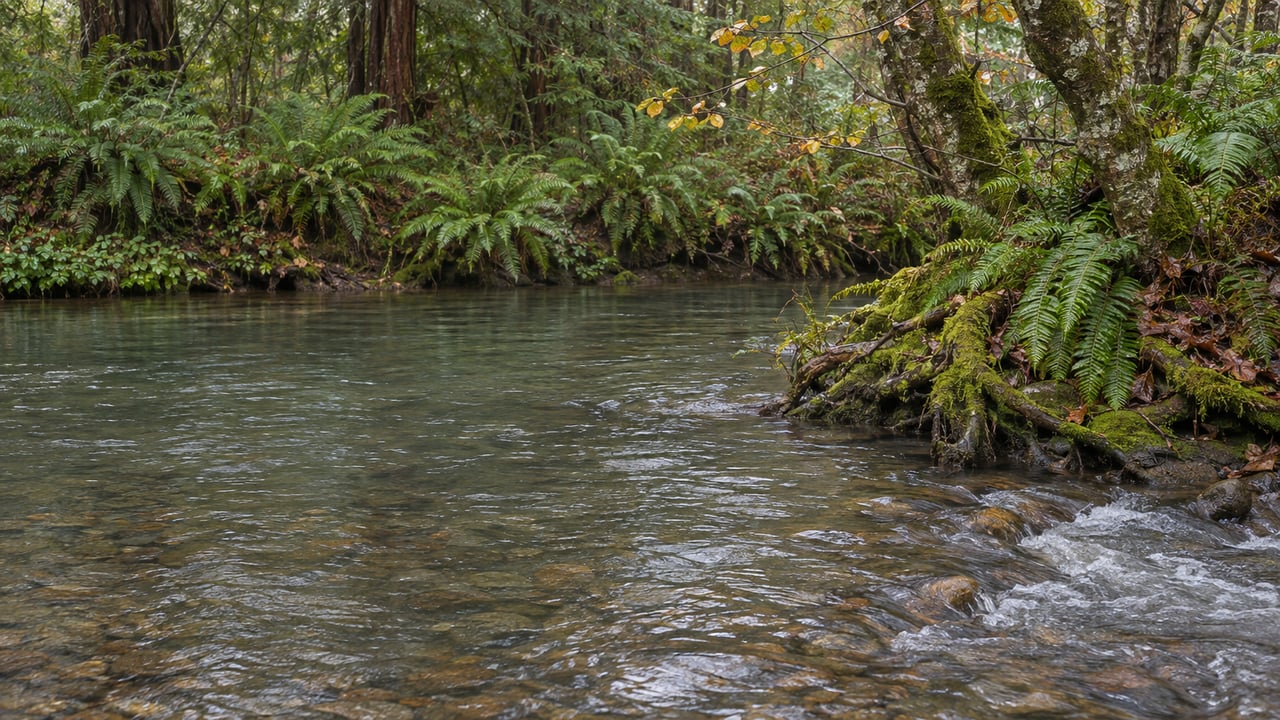
Coho salmon in Lagunitas Creek work on a three-year clock, which makes each winter's run its own family line. The fish expected to dig redds near Shafter Bridge and up the small creeks behind Woodacre this December come from the 2023–24 spawners. Marin Water's survey crew counted 343 coho redds and 693 live coho across the watershed that season, 48% above the 20-year average and 98% above the count three years earlier.
Last winter's coho came from a different line. This winter's fish come from the line that nearly doubled in its last return. How many of them make it home depends on their years in the ocean.
Three lines of fish, one creek
Marin Water has been counting adult salmon and steelhead in the Lagunitas Creek watershed since 1997. Its crews walk the creeks every week from November to March, and they count redds, the gravel nests, because muddy winter water makes counting the fish themselves close to impossible. Most coho return to spawn in their third year, so each run is its own generation and should be compared with the run three years before it.
Set out that way, this winter's line looks like this:
| Season | Coho redds counted | Live coho observed | Estimated adult spawners |
|---|---|---|---|
| 2020–21 | 173 | 343 | 346 |
| 2023–24 | 343 | 693 | 686 |
| 2026–27 | Survey season begins this month |
Between 2020–21 and 2023–24, this line nearly doubled in every column. The 2023–24 run also spread widely across the watershed. A record 25% of its spawning happened in Olema Creek, 35% in mainstem Lagunitas Creek, 33% in the San Geronimo Creek watershed, 6% in Devil's Gulch and 1% in Cheda Creek. A third of the spawning that produced this winter's fish took place in the San Geronimo Creek watershed, the creeks of Woodacre, San Geronimo and Forest Knolls.
Last winter's spectacle came from a different fish
Last fall's rain came early. The 2026 water year began on October 1, and Marin Water reported more than nine inches of rain by mid-November 2025. Lagunitas Creek rose above 100 cubic feet per second three times. Chinook, usually the first species to arrive, took the early water, and surveyors counted 149 Chinook on November 12, 2025, a single-day record for the species. The following week, 70 Chinook were seen in the short stretch between the Leo T. Cronin Fish Viewing Area and Peters Dam, and more than 50 made it up San Geronimo Creek as far as Woodacre.
The coho behaved differently. More than 100 had come upstream by early December, but Marin Water reported that very few had spawned. Most were holding in deep pools in Lagunitas and San Geronimo creeks, apparently waiting for more rain.
By February the creek was hard to read. Marin Water's CSI: Lagunitas Creek update described a record number of Chinook, a few chum and pink salmon, which are both rare here, and unusually early steelhead, all spawning in the same weeks as the coho. Through the end of January the crew had counted 347 redds of all species, and 91 were still unclassified. Only 77 had been confirmed as coho, which on its own would make the run one of the smallest in 30 years. Marin Water also reported counting more adult coho than three years earlier and expected the final coho estimate to rise once the unclassified redds were identified.
That run shared the creek with other species and waited on rain. The fish due this winter descend from the run that filled Olema Creek and a third of the San Geronimo watershed.
What the creeks behind Woodacre showed
The Salmon Protection and Watershed Network, known locally as SPAWN, surveys six small tributaries of San Geronimo Creek. Its 2025–26 survey, released by Turtle Island Restoration Network in September 2026, covered roughly 3.4 miles of stream and found 28 coho redds and 30 live coho. The redds were spread unevenly:
- Arroyo Creek: 12 coho redds and 2 steelhead redds, the most of any tributary
- Woodacre Creek: strong coho numbers, with no steelhead redds
- Montezuma Creek: 7 coho redds
- North Fork San Geronimo Creek: 2 coho redds
- Larsen Creek: 1 coho redd
- Willis Evans Creek: no salmonids observed
SPAWN explains the pattern with culverts. Undersized road culverts on many of these creeks can only be passed in short windows after large storms. "It's not surprising that the highest spawning numbers are in Arroyo and Woodacre Creek, as old culverts have either been replaced or modified into more fish-friendly designs that do not restrict access," SPAWN founder Todd Steiner said in the Turtle Island Restoration Network report.
These creeks matter more than their size suggests. The San Geronimo Creek sub-watershed makes up about 9% of the 103-square-mile Lagunitas Creek watershed. In strong years, according to SPAWN, its tributaries have held up to 30% of all coho redds in the whole watershed. SPAWN also reports that all three coho lines have trended upward since the 2018–19 and 2019–20 drought, while noting that numbers remain far below historic levels.
The tributaries and the mainstem point to the same timing. Coho need fast water to dig their redds, and in the side creeks they also need high flows just to get past the culverts. Either way, the spawn happens after the rain.
Watching it this winter
Marin Water says spawning season at the Leo T. Cronin Fish Viewing Area runs December through January. The shallow water just upstream of the parking lot is consistently one of the busiest spawning spots in Lagunitas Creek. Here is the order of things for the weeks ahead:
- Watch the forecast. The National Park Service suggests looking for salmon one to three days after a rain, once the water has had time to clear. Last December, Marin Water said it hoped the coming storm would be followed by a few clear days so people could see the spawning.
- Go to Shafter Bridge. The viewing area sits about half a mile west of the Lagunitas store on Sir Francis Drake Boulevard. Cross Shafter Bridge and turn left right away into the lot. If you see the Samuel P. Taylor State Park sign on your right, you have gone too far. Across the road, salmon can sometimes be seen jumping a small waterfall.
- Plan around the small lot. The area is open sunrise to sunset, and Marin Water notes that the lot fills quickly, especially on weekends. A weekday morning after a storm is the easiest time to find a space.
- Know the December 1 change in the state park. The Park Service also lists Camp Taylor and Devil's Gulch as viewing spots. At Samuel P. Taylor State Park, however, access to Lagunitas Creek is prohibited from December 1 through June 15 to protect spawning fish and their young. That leaves about two and a half weeks after this post for creekside walks inside the park. After that, watch from the trails and the viewing area.
- Learn what you're looking at. Females are about two feet long and dig their redds in shallow, fast water by turning on their sides and beating their tails against the gravel. Males turn bright red and chase each other for the chance to fertilize the eggs. If you see a redd with no fish on it, Marin Water's crews use a few clues. Steelhead redds tend to be smaller than coho redds, coho often leave sand behind, and Chinook usually move larger rocks.
- Follow the count. Marin Water posts survey results on its Lagunitas Creek Spawner Dashboard and sends field updates through its Creek Notes email list. These will be the first places this winter's redd numbers appear next to the 343 from 2023–24.
Thursday, November 12, is a year to the day after last season's record Chinook count. This time the run to watch for is the coho, and it should start when the December rain does.
At Marks Realty Group, our 1% for the 99% initiative gives part of every commission to nonprofits working on environmental causes, and the creeks of the San Geronimo Valley are a good reminder of why. If you have a favorite spot along Lagunitas Creek, or want to talk about life near these watersheds, we'd love to hear from you. Book an Appointment whenever it suits you.