For more than 115 years, the corner of Sutter and Buchanan meant manju, mochi and bottomless coffee at the Benkyodo counter. The New Fillmore reported that Benkyodo closed in 2022 and that its classic diner interior has since been removed. For years, Benkyodo's last week of December followed a set routine. Starting December 27, the shop stopped selling its hand-made manju and spent the days before New Year making ko mochi and kagami mochi, the stacked "mirror" cakes, which customers ordered by phone ahead of time. Nourish Co. called it Japantown's last remaining mochi shop.
Today the neighborhood's New Year mochi comes from its community center, a church and a temple. This December it also lands in an unusual stretch for the neighborhood. Peace Plaza is finishing a long renovation on one side of Post Street, and the block-long pedestrian street where Benkyodo stood is about to start a year of construction on the other.
A mochi machine that outlived its shop
Benkyodo wasn't the first Japantown confectioner to close. It also wasn't the first whose mochi tradition outlived the storefront. The Japanese Cultural and Community Center of Northern California runs its annual mochitsuki workshop with help from George Yamada, owner of the Yamada Seika manju-ya. That shop served the community for 36 years and closed in 1999. According to the JCCCNC, Yamada donated his mochi-making machine to the Center and has shared the New Year tradition with the community at the workshops.
That machine is the clearest link between the old shops and how the neighborhood makes New Year mochi now. When a shop closes, its equipment and skills can end up with an institution that runs on volunteers and registrations instead of walk-in sales. You plan around a sign-up date, a shift time and a preorder form rather than a counter's opening hours.
December 19 at 1840 Sutter
This year's JCCCNC Mochitsuki Workshop is on Saturday, December 19, at The Center, 1840 Sutter Street. Admission is $20 for Center members and $25 for nonmembers. The day runs in half-hour shifts. The first starts at 11 a.m. and the last at 4:30 p.m., and registration is online through the Center's event page.
The workshop is hands-on. Participants watch hot rice turn into mochi and learn to shape ko-mochi, fresh mochi finished with kinako, anko and other sweets. Each person can take home up to 2 pounds. Kagami mochi is a decoration that is later broken and eaten in a ritual called kagami biraki, or "mirror opening." Zōni is the soup with mochi, taro, carrot and red and white kamaboko eaten on New Year's Day. Kinako mochi is roasted, dipped in water and coated with sugar and soy flour for luck. Two pounds of mochi made on December 19 covers most of that list, as long as it lasts until January 1.
Because the time slots are short and fixed, the Center lists the workshop as a group and family activity. Households that want to go together should register for the same shift.
The pounding week after Christmas
The second half of the season belongs to the neighborhood's church and temple. Konko Church of San Francisco's 2026 events calendar lists its mochitsuki, a sweet-rice pounding, for Saturday, December 26, from 8 a.m. to 1 p.m. The same calendar has a New Year's Day service at 9 a.m. on January 1, 2027, and hatsumode, the first shrine visit of the year, from 11 a.m. to 4 p.m. on January 1 through 3. Those hours are longer than in 2017, when Nourish Co. listed the church's New Year's Day hatsumode as a single hour, 8 to 9 a.m.
At Sokoji, the Soto Mission of San Francisco, the mochitsuki is held every year at the end of the year. Last year it was December 28, from 9 a.m. to 4 p.m., with pickup between 1 and 4 p.m. People could take a turn with the usu and kine, the mortar and wooden mallet, buy mochi and kenchin-jiru soup, and watch children shape their own round mochi. The temple asked for advance orders because it couldn't guarantee mochi for sale on the day. Last year's order form was posted on Sokoji's news page in early November. If Sokoji follows the same pattern this year, that page is where its order form will appear.
That leaves the rest of the New Year table. Nijiya Market opened preorders for its 2027 osechi, the traditional New Year meal, imported from Japan, on November 19. Orders can be placed online or in the store, quantities are limited, and pickup is in-store only on Thursday, December 31. The Japantown store is at 1737 Post Street, #333. Nijiya's online shop also lists packaged maru mochi from Sato Shokuhin.
Put together, the season comes in two waves. The Center's workshop on Sutter is the week before Christmas, and the church and temple poundings follow in the days after it. Osechi pickup on Post Street is New Year's Eve.
Osaka Way's last New Year before a year of construction
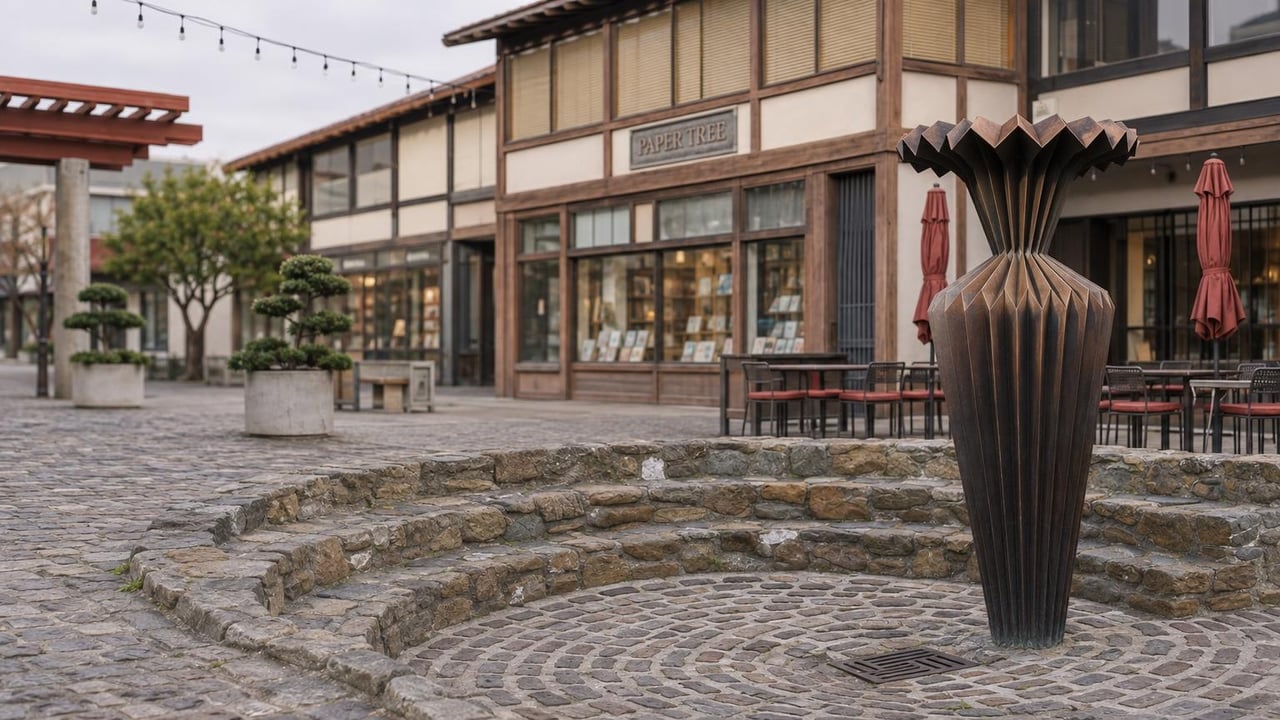
Benkyodo's old corner is the north end of Osaka Way, the one-block pedestrian section of Buchanan Street between Post and Sutter. SF Public Works describes it as paved with a river of cobblestones linking two fountains of origami flower forms by Ruth Asawa, set inside low, circular stone walls. The mall was designed in the 1960s.
On October 31, the Japantown Cultural District billed its One Beat One Street taiko afternoon, with Jiten Daiko and OH-IN Taiko, as the final live performance on Osaka Way before renovations begin in January 2027. SF Planning estimates construction will take 12 months. The project is funded in part by a $5 million California Natural Resources Agency grant that then-Assemblymember Phil Ting secured at the end of 2021. It was developed with the Japantown Task Force, the Japantown Community Benefit District, the Nihonmachi Parking Corporation and Ruth Asawa Lanier, Inc.
The community's goals for the work are better access for seniors and people with limited mobility, rehabilitation of the Asawa fountains, and stronger storefronts along both sides of the mall. The fountains are staying and being restored. This December and the first days of January are the last chance to see Osaka Way as it has looked for decades before work begins. Walking from the Center on Sutter down to the Post Street side runs the length of it.
Peace Plaza, on the other side of Post
Across Post Street, the larger renovation is near the finish. Japantown Peace Plaza is a 30,000-square-foot public space between Post Street and Geary Boulevard. It is also the roof of an underground parking garage. The plaza was built in the 1960s and partly renovated in 2000. In 2016 the plaza was found to have significant waterproofing failures that caused problems for the garage below, and those failures led to a full renovation. The project's total budget is $36,277,650. Construction began in April 2024, and as of a June 18, 2026 staff report it was about 75% complete, with public opening projected for fall 2026.
San Francisco Recreation and Parks' October 2 construction update covered the final areas. Crews were working around the Peace Pagoda and two fenced seating nooks along Post Street. Drainboards and geofoam were being placed around the pagoda ahead of a topping slab, and its stepped hexagonal podium was being prepared for waterproofing. Painting of the pagoda was about 90% done, with only the first level left. The same update gave walking routes into the Japan Center malls. From Geary Boulevard, the route is through the parking garage to both the East Mall and West Mall. From Post Street, it is the posted detours through the center of the plaza. An accessible sidewalk detour ran along the north side of Geary between Laguna and Buchanan. Check Rec and Park's project page for the latest routes before heading to the malls, especially with an osechi order to carry back to the car.
From mid-December through January 3, Japantown's holiday calendar happens between these two projects, with one nearly finished and the other about to start. The Center's workshop is December 19, Konko Church pounds mochi December 26, osechi pickup is December 31, and hatsumode runs January 1 through 3. For a family that wants a full Japantown New Year, two dates need early action: registration for a JCCCNC workshop shift and, if Sokoji repeats last year's process, a mochi preorder. Both fill on the organizers' schedules. For more of the city's season, our guides to the Union Square ice rink and Lightscape at the San Francisco Botanical Garden cover two more December evenings, and our San Francisco neighborhood page has more on the city.
At Marks Realty Group, we like it when a neighborhood keeps a tradition going after the shop that started it has closed, as Japantown has with a donated mochi machine and church and temple poundings. If Japantown's New Year is part of how you picture life in San Francisco, and you're thinking about what that means for where you live next, we'd be glad to hear about it. Book an appointment and tell us what your year-end traditions look like.